WORLD WAR 1 FACTS | SUMMARY OF WW1 FOR KIDS
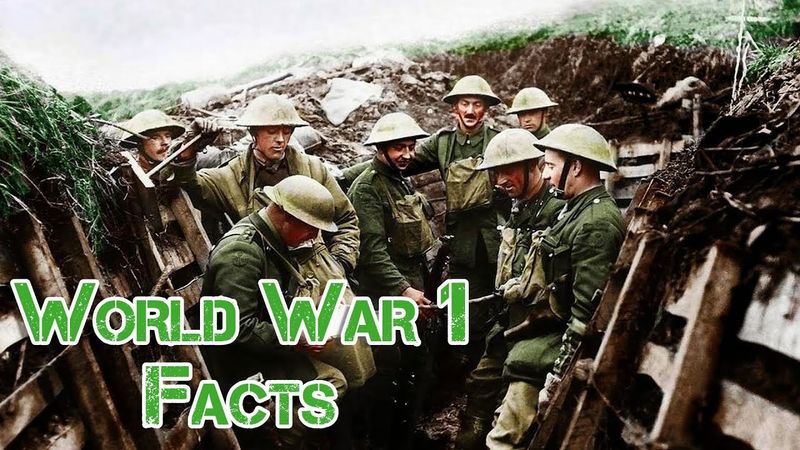
Download information and video details for WORLD WAR 1 FACTS | SUMMARY OF WW1 FOR KIDS
Uploader:
KidsKonnectPublished at:
5/20/2018Views:
635.7KDescription:
Video Transcription
World War I, also known as the First World War, was a global war centered in Europe that began on 28th of July 1914 and lasted until the 11th of November 1918.
The war lasted exactly four years, three months, and 14 days.
Before World War II began in 1939, World War I was called the Great War, the World War, or the war to end all wars.
135 countries took part in World War One and more than 15 million people died.
In this video, we're going to cover lots of facts and information about World War One.
The conflict involved nearly all of the biggest powers in the world and was focused around two alliances, the Allies and the Central Powers.
The countries of the Allies included Russia, France, the British Empire, Italy, United States, Japan, Romania, Serbia, Belgium, Greece, Portugal and Montenegro.
The Central Powers included Germany, Austria-Hungary, Turkey and Bulgaria.
Some of these WWI facts are incredible and very interesting when you consider that the events happened in a very recent history.
World War I began on June 28th 1914.
It was triggered by the assassination of the Archduke Franz Ferdinand of Austria and his pregnant wife Sophie.
Archduke Franz Ferdinand was the nephew of Emperor Franz Joseph and heir to the throne of Austria and Hungary.
The assassination was planned by a Serbian terrorist group called the Black Hand and the man who shot Franz Ferdinand was a Bosnian revolutionary called Gavrilo Princip.
One of the primary causes of World War I was a difference over foreign policy.
Although the assassination of Franz Ferdinand triggered the war, that was only the immediate cause.
Differences over foreign policy between the major world powers was the underlying cause of the war.
There were many other causes as well.
A tangle of alliances that were made between countries to maintain the balance of power in Europe only served to escalate the scale of the conflict.
The Bosnian crisis where Austria-Hungary took over the former Turkish province of Bosnia in 1909 angered Serbia.
Countries were building their military forces, their arms and their battleships.
and it was only a matter of time before they wanted to use them.
Countries that had lost territories wanted to regain them from previous conflicts and build their empires.
The Moroccan crisis where the Germans were protesting in 1911 against the French possession of Morocco was also a factor.
World War I was known by a number of different names.
Other names for the war included the War to End All Wars, the War of the Nations,
World War I, and the Great War.
The Americans only actually joined World War I after 128 Americans were killed by a German submarine.
In 1915, the British passenger ship, Lusitania, was sunk by a German submarine.
In all, 1,195 passengers, including 128 Americans, lost their lives.
Americans were outraged and put pressure on the US government to enter the war.
President Woodrow Wilson wanted a peaceful end to the war but in 1917 when the Germans announced that their submarines would sink any ship that approached Britain, Wilson declared that America would enter the war and restore peace to Europe.
The United States entered World War I on April 6th, 1917.
Over 8 million soldiers died in World War I and 21 million were injured.
65 million troops in total were mobilized during the war.
58,000 British soldiers were lost on the very first day at the Battle of the Somme.
World War I was also when chemical weapons were used for the first time.
The chemical weapon of choice in World War I
was mustard gas the united states only spent seven and a half months in actual combat during that time 116 000 soldiers were killed and 204 000 were wounded in the battle of verdun in 1916 there were over a million casualties in 10 months by 1918 german citizens were striking and demonstrating against the war
The British Navy blocked German ports which meant that thousands of Germans were starving and the economy was collapsing.
Then the German Navy suffered a major mutiny.
After German Emperor Kaiser Wilhelm II abdicated on November 9th 1918, the leaders of both sides met at Compiègne, France.
The peace armistice was signed on November 11th and by the end of the war four empires,
The Russian Empire, the Ottoman Empire, the German Empire and the Austro-Hungarian Empire had collapsed because of World War I.
In 1919, the Treaty of Versailles officially ended the World War.
The treaty required that Germany accept full responsibility for causing the war and make reparations to some of the allied countries.
They also had to surrender some of their territory to surrounding countries, surrender its African colonies and limit the size of its military.
The treaty also established the League of Nations to prevent future wars.
The League of Nations helped Europe to rebuild and 53 nations had joined by 1923.
But the US Senate refused to let the United States join the League of Nations and as a result, President Wilson, who had established the League, suffered a nervous collapse and spent the rest of his term as an invalid.
Germany joined the League of Nations in 1926, but many Germans were very resentful of the Treaty of Versailles.
Germany and Japan withdrew from the League of Nations in 1913 and then Italy withdrew three years later.
The League of Nations was unable to stop the German, Italian and Japanese from expanding their power and taking over small countries.
Many believe that World War One never really ended and that World War Two never would have happened if not for World War One.
And now a few more really interesting and amazing facts about World War One.
Did you know, for example, that an explosion on the battlefield in France was actually heard in England?
Most of World War One was fought in mud and trenches, but a group of miners would also dig underground tunnels and detonate mines behind the enemy trenches.
In Belgium, these miners detonated over 900,000 pounds of explosive at the same time, destroying the German front line.
The explosion was so loud and powerful that it was heard by the British Prime Minister, David Lloyd George, 140 miles away in Downing Street, London.
Many World War I journalists also risked their lives to report on the war.
The government tried to control the flow of information from the front line during the war and journalists were banned from reporting.
The War Office considered reporting on the war as helping the enemy and if journalists were caught, they faced the death penalty.
A handful of journalists did risk their lives to report on the war and the harsh realities that the soldiers faced.
Over 12 million letters were delivered to the front line every single week.
Even during times of war, it only took two days for a letter to be delivered from Britain to France.
A purpose-built mail sorting office was created in Regent's Park before the letters were sent to the trenches on the front line.
By the time the war ended, over 2 billion letters and 114 million parcels had been delivered to the trenches.
Another very interesting fact that you may not know, plastic surgery was invented because of World War I.
One of the very earliest examples of plastic surgery came during World War I when a surgeon by the name of Harold Gillies helped shrapnel victims with terrible facial injuries.
Shrapnel caused many facial injuries in World War I and the twisted metal would inflict far worse injuries than the straight line wounds of a bullet.
Dr. Gillies pioneered the early techniques for facial reconstruction.
The youngest British soldier in World War I was just 12 years old.
Over 250,000 underage soldiers were allowed to fight in World War I.
The youngest was a boy named Sidney Lewis who was just 12 years old but he lied about his age to join.
There were many thousands of underage boys who enlisted and most of them lied about their age.
Some joined for the love of their country while others did it to escape from the lives and the poor conditions that they were living in.
Another invention that came as a result of World War One are blood banks.
It was during World War One that the routine use of blood transfusion was used to treat wounded soldiers.
Blood was transferred directly from one person to another.
In 1917 a US Army doctor by the name of Captain Oswald Johnson established the first blood bank on the Western Front.
He used sodium citrate to prevent the blood from coagulating and becoming unusable.
The blood was kept on ice for as long as 28 days and was transported when needed to casualty clearing stations for use in life-saving surgeries on soldiers who had lost a lot of blood.
Nine out of ten British soldiers actually survived the trenches.
British soldiers actually were rarely in the firing line in World War One,
They moved around the trench system constantly and were usually kept from the dangers of enemy fire.
Most British soldiers life in World War One would have been regular routine and boredom.
It's also said that British army generals had to be banned from going over the top.
There's a common stereotype that ordinary soldiers were used by the higher-ups.
Lions led by donkeys, as the saying goes.
The donkeys being the incompetent generals who didn't spend any time on the front line
while thousands of soldiers, the lions, were killed.
Actually so many British generals wanted to fight they had to be banned from going over the top of the trenches because they were being killed and the experience of a general was too important to lose.
If you enjoy these amazing facts about World War One, please do hit the like button below and subscribe if you're new to the channel.
Every week we release new facts and information about historical events and places, specifically for kids and teachers in the classroom.
Similar videos: WORLD WAR
Road to WW2: 1935 - 36 - Epic History Reaction
Büyük Savaş: I. Dünya Savaşı Ne Getirdi? / Emrah Safa Gürkan - Historik 64

Little Big World | Compilation of time-lapse tilt-shift & drone shots
The Dawn of the Cold War
I Wargamed with NATO - Inside the Cross-Domain Command Wargame (2025)